RRSP vs TFSA vs FHSA — Which Account Should You Max First in 2026?
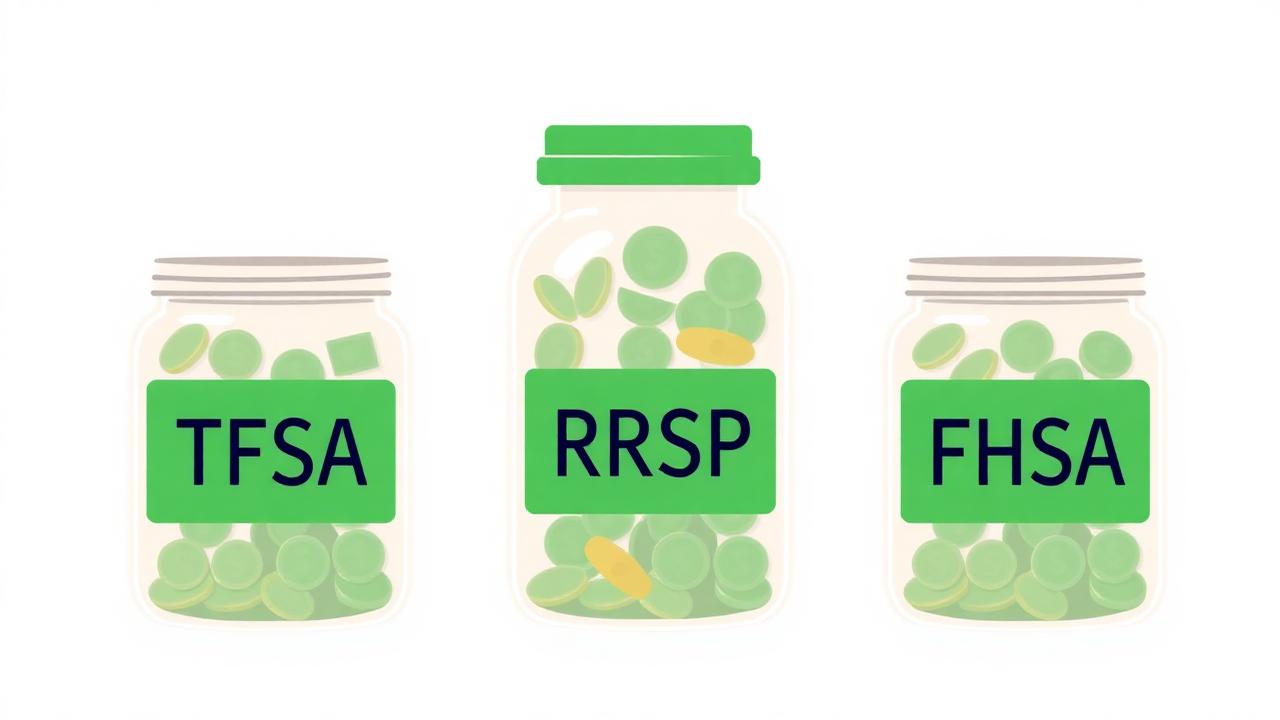
With three registered accounts available — TFSA, RRSP, and FHSA — most Canadians can't max them all. Combined, the annual contribution room can exceed $25,000 plus 18% of your income for the RRSP. Most working Canadians are choosing where to deploy $5,000–$15,000 of savings each year. Here's a practical framework for deciding which account to prioritize in 2026.
The Quick Decision Framework
- Buying your first home in the next 5 years? → Max the FHSA first ($8,000/year). It's the only account that gives you a tax deduction AND tax-free withdrawal for a home purchase.
- Income under $55,000? → TFSA next. The RRSP deduction isn't worth much at lower brackets.
- Income above $55,000? → RRSP next. The deduction saves you 30–50% in taxes depending on your province.
- Still have room? → Fill whichever you haven't maxed yet, prioritizing the TFSA for flexibility.
2026 Contribution Limits at a Glance
| Account | 2026 Limit | Lifetime Max |
|---|---|---|
| TFSA | $7,000 | $102,000* |
| RRSP | 18% of income | $32,490 max |
| FHSA | $8,000 | $40,000 |
*If eligible since 2009 and never contributed.
Why the FHSA Wins for First-Time Buyers
The FHSA is the only account in Canada that combines:
- Tax-deductible contributions (like an RRSP)
- Tax-free withdrawals for a home purchase (like a TFSA)
- No repayment requirement (unlike the RRSP Home Buyers' Plan)
- Carry-forward of unused room (up to one year)
At a $55,000 income in Ontario, an $8,000 FHSA contribution saves you roughly $2,040 in taxes — AND the money grows tax-free until you withdraw it for a qualifying home purchase. There's no equivalent account in any other developed country with this combination of features.
If you don't end up buying a home, the FHSA balance can be transferred tax-free to your RRSP. It's a no-lose proposition for anyone who might buy their first home in the next 15 years.
The TFSA vs RRSP Income Crossover
The conventional wisdom says RRSP above ~$55,000, TFSA below. Here's why:
- Below $55,000, your marginal rate is 20–29%. RRSP deduction saves you 20–29 cents per dollar.
- Above $55,000, your marginal rate jumps to 30–40%+. The RRSP deduction is worth more.
- If you expect your retirement income to be lower than your current income, the RRSP is always beneficial — you deduct at a high rate today and withdraw at a low rate in retirement.
- If you expect your retirement income to be higher than today (e.g., young professional with large pension expectations), the TFSA can be more valuable even at higher current incomes.
Use our marginal tax calculator to see your exact rates by province.
Sample Strategy 1: $45,000 Income, Renter, No Home Plans
- TFSA: $7,000 → grows tax-free, withdraw any time for any reason
- RRSP: $0 (deduction is worth ~$1,470 at this bracket — TFSA flexibility is worth more)
- FHSA: Skip if no home plans
- Net contribution: $7,000 | Tax savings now: $0 | Tax savings on future withdrawals: 100%
Sample Strategy 2: $75,000 Income, First-Time Buyer in Ontario
- FHSA: $8,000 → saves ~$2,480 in taxes
- RRSP: $5,000 → saves ~$1,550 in taxes
- TFSA: $7,000 → grows tax-free forever
- Total invested: $20,000 | Total tax savings: $4,030 | Effective cost of $20K of saving: $15,970
Sample Strategy 3: $120,000 Income, Existing Homeowner, BC
- RRSP: $21,600 (18% of $120K, up to your room) → saves ~$8,400 in taxes
- TFSA: $7,000 → tax-free growth
- FHSA: Not eligible (already owns a home)
- Spousal RRSP top-up: Consider if spouse earns less, for income-splitting in retirement
Common Mistakes to Avoid
Mistake 1 — Putting RRSP money in a low-yielding HISA at age 30. The RRSP is meant for long-term retirement growth. A 30-year-old with $5,000 in a HISA at 2.5% inside an RRSP loses decades of compounding versus a balanced portfolio. The TFSA is the right home for short-term cash, not the RRSP.
Mistake 2 — Not using the FHSA because "I'm not ready to buy yet." You can hold an FHSA for up to 15 years. Opening one and putting in even $1 starts the contribution-room clock. Then you can carry forward $8,000/year in unused room (up to one year) for the times you can contribute.
Mistake 3 — Maxing the RRSP at the cost of an emergency fund. RRSP withdrawals trigger withholding tax (10–30%) and permanent loss of contribution room. Build a 3–6 month emergency fund in your TFSA before aggressively maxing the RRSP.
What About All Three at Once?
If you have the cash flow to fund all three accounts simultaneously, do it. There's no rule against contributing to TFSA, RRSP, and FHSA in the same year. The "which first" question only matters when you have to choose. For someone with $25,000 of available savings: $8K to FHSA + $7K to TFSA + $10K to RRSP covers the FHSA limit, fills the TFSA, and captures most of the RRSP benefit at a $75K income.
Source: Canada Revenue Agency — TFSA, RRSP, and FHSA contribution limits (canada.ca/en/revenue-agency); 2026 federal and provincial marginal tax rates.
Related Reading
Editorial disclaimer
This article is published by LoonieLabs for general information only. It is not financial, tax, legal, accounting, or immigration advice and must not be relied on as such. Rules, dollar figures, interest rates, and program eligibility change — always verify with the Canada Revenue Agency, IRCC, or a qualified professional before acting. Spotted an error? See our corrections policy. Last reviewed: April 14, 2026.
Frequently Asked Questions

Written and reviewed by Shrey Patel — Founder & Editor-in-Chief
Winnipeg, MB · Figures cross-checked against official tax & benefits sources · Last reviewed April 14, 2026 · LinkedIn
Founder of LoonieLabs · based in Winnipeg, MB · writes and reviews every page on the site I oversee every figure on this page personally — verified against primary sources (CRA, IRCC, Statistics Canada, the Bank of Canada, or the originating provincial ministry). LoonieLabs has no affiliate relationships with any bank, credit card, or immigration consultant featured on this site. Spotted a mistake? Tell us.
Published by LoonieLabs.